
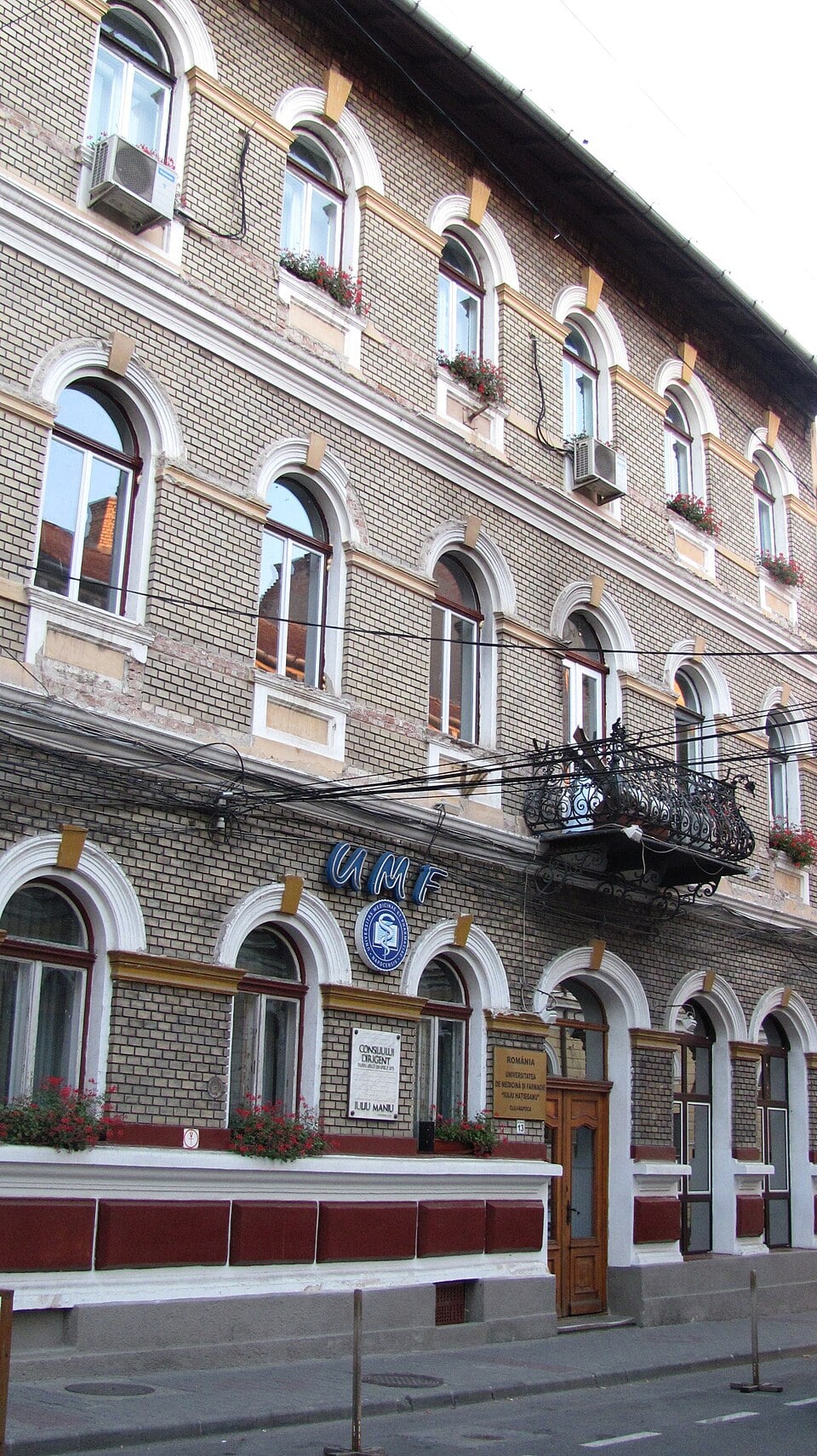
Faculty of Medicine building, Iuliu Hațieganu University in Cluj-Napoca — Photo: Wikimedia Commons
Iuliu Hațieganu University of Medicine and Pharmacy
Overview & About
A university with the highest educational standards in the heart of Transylvania. Medical education at this institution traces back to the 1775 Medical-Surgical School of Cluj, making it Transylvania's oldest center of medical education.
Facilities, Heritage & Key Features
Key facts regarding academic heritage, clinical and research facilities, and quality standards
Founded in 1919 as the Faculty of Medicine of Cluj; the oldest medical education institution in Transylvania
Home to the Valeriu Bologa Museum of the History of Medicine and Pharmacy; publisher of the Clujul Medical journal since 1920
Two excellence centers and seven research centers
~8,000 students (7,153 undergraduate and 876 postgraduate)
Degree Levels & Academic Programs
Undergraduate, Master’s, and Doctoral programs offered at this institution
Medicine (6 years), Dentistry, Pharmacy, Nursing (4 years), Radiology/Medical Imaging and Balneophysiokinetotherapy (3 years)
13 Master's programs; doctoral degrees and residency programs
Rankings & Global Standing (Sourced)
Documented positions in recognized global ranking systems with direct source links
301–350 band (up from 401–450 in 2025) — re-verify this figure on umfcluj.ro’s own rankings page before publishing, as an older 351–400 figure also appears there
1st among Romanian universities
Overall 801–1000 band
Tuition & Fees
Based on official publications for the 2026-2027 academic year
What does it cost to live and study in Cluj-Napoca?
Estimate monthly expenses for housing, student dorms, groceries, public transit, and utilities in Cluj-Napoca using our interactive calculator.
Frequently Asked Questions
What is the tuition fee at Iuliu Hațieganu University of Medicine and Pharmacy?
Tuition ranges across programs: First-year Medicine/Dentistry/Pharmacy: €10,000.
Is Iuliu Hațieganu University of Medicine and Pharmacy's degree recognised in Iran?
For this university, the Iranian authority that evaluates degrees is the Ministry of Health and Medical Education (the "Movahed" system), not the Ministry of Science. Based on our data, this university appears on the Ministry of Health's approved list. One point that is widely misunderstood: the list of "approved foreign universities" published by the Organization for Students Affairs (SAORG) does not cover medical universities at all. That office states explicitly that it assesses "only fields that fall within the remit of the Ministry of Science." So if you cannot find this university on that list, it has not been rejected — it is simply outside the scope of that list. But one point that could change the outcome for your own degree: Ministry of Health approval concerns medical fields, not necessarily every programme the university offers. If your programme is not clinical (biomedical engineering, medical physics, or health services management, for example), the authority evaluating your degree may be the Ministry of Science rather than the Ministry of Health. We could not confirm exactly where Iran draws that line — so before enrolling, check the position for your specific programme, not just the university's name.
Are English-taught programs available at Iuliu Hațieganu University of Medicine and Pharmacy?
Yes, English-taught and Romanian-taught degree programs are available with preparatory language year options. However, exact teaching languages vary by degree and department and should be confirmed directly with university admissions.
What does it take to have a Romanian medical degree evaluated in Iran?
Having a degree evaluated by Iran's Ministry of Health is not only a review of documents. According to the official FAQ of the ministry's educational services centre, each field involves an examination in Iran: for general medicine the pre-internship exam, for pharmacy the evaluation exam, and for general dentistry the national exam — held, according to that same source, usually twice a year. The same source says some applicants are exempt from the exam, but refers the conditions to the "regulation on the evaluation of graduates from abroad" rather than stating them. We have not read that regulation directly, so we say nothing about who qualifies for an exemption. One specific point is stated, though: in pharmacy, even applicants exempt from the exam are required to complete 8 credits of pharmacy internship. Three further rules worth knowing before you choose a university rather than after: 1. If you study at a university that is not on the approved list, the official advice is to transfer to an approved one as soon as possible, and at least half of the programme must have been completed at an approved university. 2. Distance and correspondence study is, in the explicit words of the rules, "invalid and not evaluated". 3. For those who began studying abroad from the start of 2019, failing to finish within the permitted duration has consequences; and if you hold a student military deferment, both your studies abroad and any supplementary course inside Iran must finish within that deferment period. For your own situation, the authority is the Ministry of Health's educational services centre: mohed.behdasht.gov.ir/Assessment
More Information & Admissions
Visit the official university portal for exact requirements and academic calendar.
Want us to evaluate your profile?
Submit your basic information to find the right path for you.